
Follow us on LinkedIn for more updates here.
2026 meeting
21st-22nd April 2026.
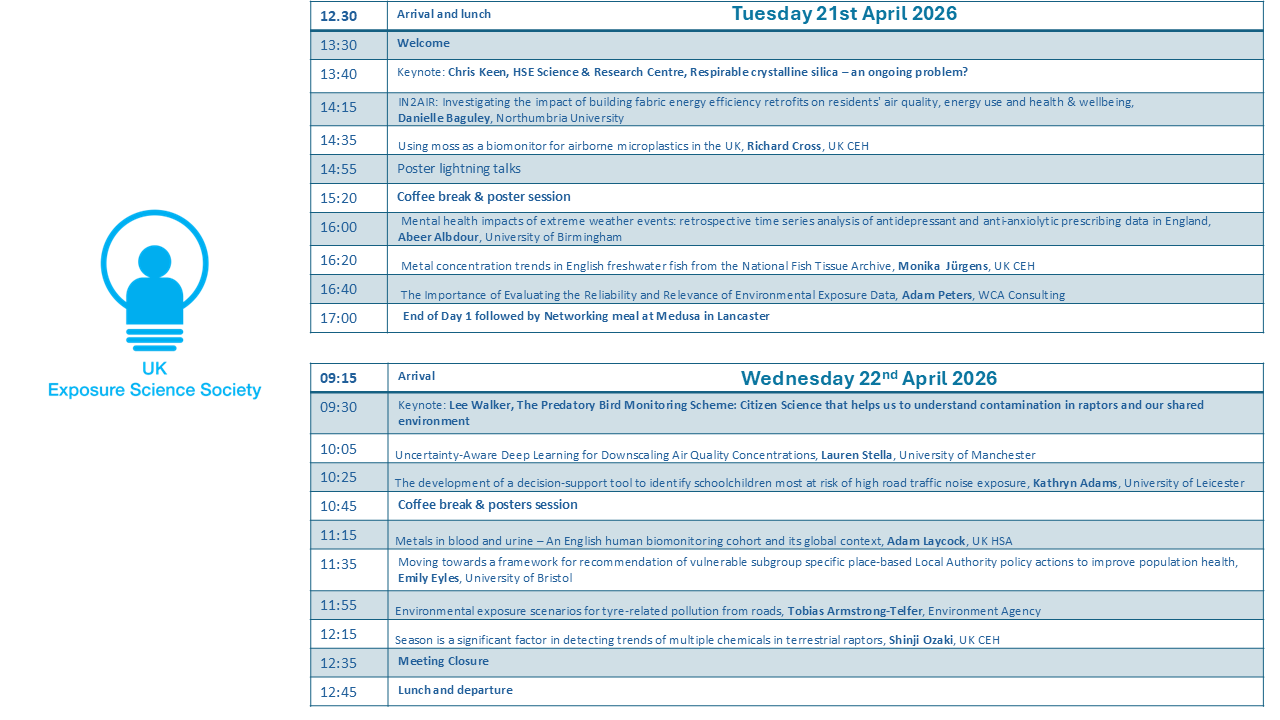
The programme is now available!
UK Centre for Ecology & Hydrology, Lancaster
Registration and abstract submissions are now open! Click the BOOK NOW here for both.
Keynotes
The Predatory Bird Monitoring Scheme: Citizen Science that helps us to understand contamination in raptors and our shared environment by Lee Walker, Vertebrate Ecotoxicologist at UKCEH
With the help of the public, who send us bird carcasses, this unique long-term monitoring programme tracks the levels of contaminants in the livers and eggs of various predatory bird species across Britain. Our research aims to understand the environmental fate of chemical contaminants that accumulate via food chains in the tissues of predatory birds. The data generated provides evidence leading to, and monitoring the success of, chemical risk management measures. Chemicals in our monitoring programme include toxic metals, rodenticides and PFAS, commonly called forever chemicals.
‘Respirable crystalline silica – an on going problem?‘ by Chris Keen, Principal Occupational Hygienist, HSE UK
Occupational exposure to respirable crystalline silica (RCS) is widespread and occurs across multiple industry sectors. Uncontrolled exposure to RCS can cause serious, irreversible lung diseases, including silicosis and lung cancer. Whilst the toxicity of RCS has been known for centuries, over-exposure continues to occur in the 21st century.
This presentation will explain where, and how, occupational exposure to RCS occurs. It will explain what is currently known about exposures in Great Britain, and the level of risk associated with those exposures. It will also run through the range of options to adequately control exposures which, if properly implemented, could eliminate RCS related lung disease entirely. The presentation will also discuss knowledge gaps, and what might be done to address these.